mercoledì 24 febbraio 2010

Filming the Aqua Virgo

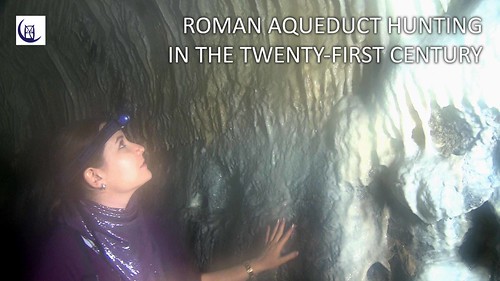
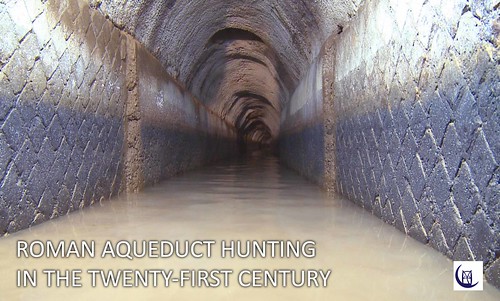
Cold, wet, in the pitch black, twenty-five metres under the city of Rome, we pushed forwards against the water of Marcus Vespanius Agrippa’s Aqueduct, which has flowed continuously since 19BC, and I prayed that our new high-definition camera wasn’t going to drop into the water and flow all the way back to the Trevi fountain.


Our first filming adventure inside an aqueduct was a one-off. We had spent six months negotiating for access to the Aqua Virgo and we knew we weren’t going to have a second chance. Wearing chest-high fishermen’s waders, which often barely covered us from the water, six of us set off from the “Pincio Snail” near the Spanish Steps, and began to push our way upstream.


Often a Roman Aqueduct is portrayed as being carried on elevated arches across the countryside, but in fact, this is only sometimes the case.  The Aqua Virgo has survived almost intact for so many centuries precisely because it travels underground for almost it’s entire route, from Salone on the ancient via Collatina in the east of the city, originally to Agrippa’s baths, of which the Pantheon formed part, and now to it’s display fountain, the Trevi, built in 1732-1762 By Nicolo Salvi.

We took took some very powerful lights to the Aqua Virgo, and we were able to light the underground chambers in a way which we believe has never been done before.  But it was not without difficulty.   We took two battery packs with mains inverters because the lights work on 240V, but only one of us was able to carry a battery pack, and within that pack, one of our batteries had become detached.

Our consultant speleologist was carrying both the battery pack and the light, whilst I was filming, and the 240V cable between the two very nearly dangled in the water on several occasions!  Very soon, furthermore, the mains inverter started to beep, indicating that we were running out of power, so for 40 minutes or so, we had to turn the lights off and push upstream with only the power of tiny safety lights we were wearing on our heads.

The Aqueduct Hunter Diary

My name is Ted O’Neill, I come from Finchampstead in the U.K. and I am blogging from Rome, where my company is researching and filming the remains of the ancient Roman Aqueducts.


Ancient Rome was not only a Military Powerhouse, but also, in many ways an unsurpassed civilisation and healthy population centre, all powered by clean, fresh water.  There was more fresh water arriving in Rome in the year 110 AD than arrives in New York in 2010 AD.   The water was not only good to drink, coming from fresh mineral springs and aquifers around volcanic basins, but it was also a source of renewable energy to roman industry.


In the course of our research we have made some discoveries, and last week, we announced one of them to the world.   The Hotel Quirinale Press Conference was a highlight so far of this project, if not in terms of adventure, then definitely in terms of recognition and fun.

We had not closed our eyes for more than an hour in the three or four days before the press conference.   It was manic.   We had planned to use those days for editing video, but the journalists just didn’t give us a chance.


The conference was hosted by the Mayoress of Manziana, the little town where the chapel / nymphaeum and Traianic water source is located.  Archaeologist Lorenzo Quilici spoke of the unparalled importance of the site, as one of the only Aqueduct sources known in and around Rome, and how it remained unknown for so many centuries due to being completely underwater.

The Aqua Traiana was one of the last, and one of the greatest aqueducts built by the Roman Empire, and it flowed around Lake Bracciano – a volcanic lake to the north of Rome in a question-mark shape, taking pure aquifer water from sources around the volcanic basin, then delivering that water to Rome along a thirty-five mile long conduit.


In the coming weeks I shall be recounting our adventures – Hunting for the Roman Aqueducts, and evidence of their ancient power and engineering.


Images of our work can be seen at our flickr site:  flickr.com/meonhdtv