mercoledì 3 marzo 2010

That rascally fig tree

We have one serious enemy in our attempt to preserve the spring chamber and spring gallery of the Aqua Traiana.

More stubborn than the nuttiest old archaeologist, more rapacious than the Emperor Trajan himself, is a certain damned fig tree, sitting adjacent to the ‘church’ chamber itself, from where it sends its roots down into the ‘spring’ chamber or ‘water capture’ chamber and down into the aqueduct.


The spring chamber was lined with rock-hard waterproof hydraulic cement, and that cement was painted with Egyptian blue paint - paint which gives us a sure and certain date for the construction of that chamber.

Unfortunately, since the spring chamber was drained, there is now a layer of roots between the painted roman cement and the structure of the wall.


Fig trees are one of the greatest enemies of ancient monuments.  The day that your doctor told you that eating figs is a great source of Calcium and gives you strong teeth and finger nails, you might have guessed that fig tree roots absorb lots of Calcium from the soil.  You’d have been right!

Root-tips are covered in bio-films which help them absorb mineral nutrients, and through that film, through either clay or hetrotrophic bacteria, H+ Hydrogen Ions are exchanged with Metal Ions, such as Ca2+ Calcium Ions in mineral fragments.   It’s called Bio-mobilisation.
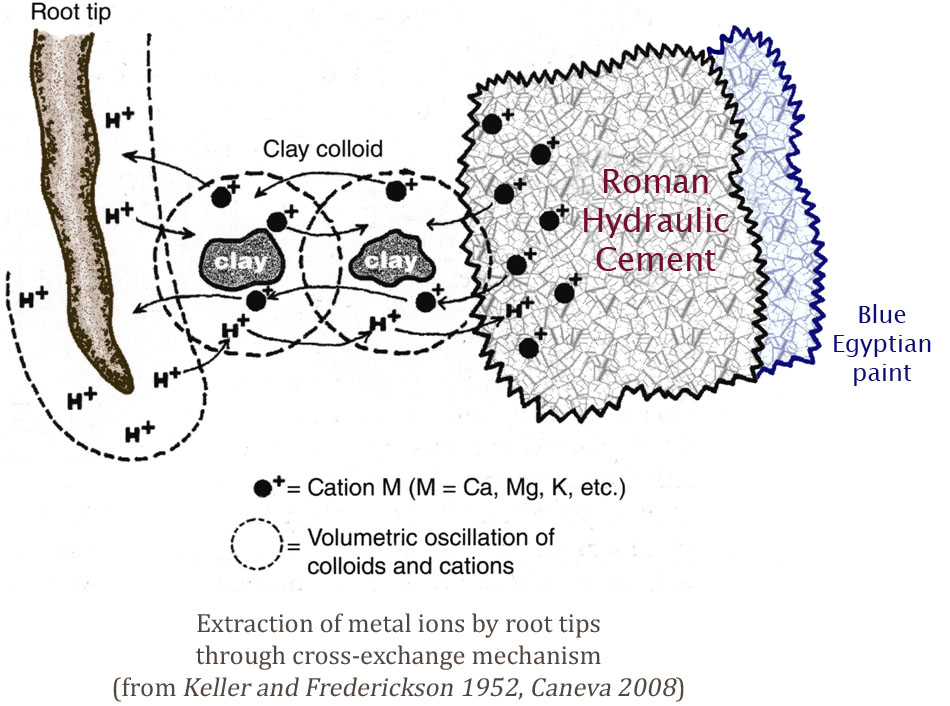


So those cheeky fig tree roots have been busily sucking all the Calcium out of the rock-hard hydraulic cement, so that it’s no longer hard at all.  In fact it’s distinctly friable and crumbly.  Recently, we had to keep our mouths closed and grind our teeth as we watched a VIP guest break off a big chunk of the hydraulic cement and crumble it between his fingers.

We would like to see the Roman Hydraulic-Cement preserved.  It is a significant technical component of this unique remaining example of roman engineering, and if we lose it, we also lose the Egyptian Blue paint – which was so expensive that it proves that this location was a place of great importance.

So a key question is how to preserve this hydraulic cement or ‘intonaco’.   It is possible that the live roots are currently holding the intonaco in place.  Eventually the destructive fig tree needs to be removed, but if we kill the tree and the roots die, the intonaco could just drop off the walls and crumble on the floor.


Two days ago I met the young owner of the site for the first time.  He is eager to clean up the place, and be seen to take good care of it.  He wants to cut down the fig trees – in fact, he may already be doing so.

To stop and think, or to go for it?  To be or not to be?

To take a chain saw to that cheeky old fig tree, or to leave it standing?

That is the question.

martedì 2 marzo 2010

Going to meet the owners


It's Tuesday 2nd March, about 4 o'clock in the afternoon, and I've got my first appointment to meet the owners of the Aqueduct Spring source that we announced in January.   I'm kind of scared and on-edge, and I've asked a representative of the local archaeological society to come with me.
The Aqueduct Source is hidden 'under' a church in a wood in agricultural land north of Rome, and whilst we've been there many times before with the local council representatives and water engineers, we've never so far actually met the owners, which I feel is a bit lax.
My personal preference for many months has been to try to ingratiate ourselves with the people who have been taking care of the beautiful monument for so many years and go there with their permission, but unfortunately, we have visited here previously with people who tend to ride roughshod over them.
Today, hopefully, we're going to change that.   I have an appointment at 18:00 with either the owner's son or grandson, I'm not quite sure which.
We shall see!

The Old Spiral Staircase

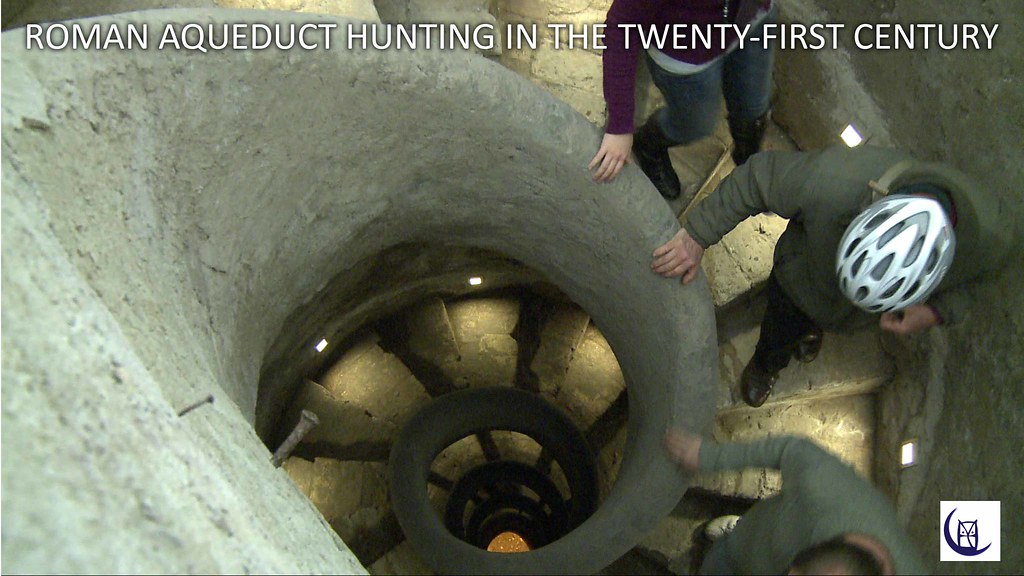
The old Spriral Staircase curls down for twenty-five metres into the eery space beneath the city of Rome, where archaeology and ancient tunnels have laid undisturbed since a forgotten time.
Peering down from the top as we prepared to film the aqueduct, we saw the shimmer of the purest water rippling yellow-gold lights right in the centre of the stairway where the ancient Aqueduct passes beneath.


But the entrance to the Pincio “Snail” as the Italians call a spiral stairway lies only sixty metres from a well known landmark where millions of tourists pass each year. At the top of Rome’s well loved Spanish Steps, adorned with young couples taking photos and giving roses, there is an impressive villa called Villa Medici. And to the side of the principal entrance to Villa Medici is a small door with an engraved stone: “Alla Chiociola del Pincio” – to the Pincio Snail.
The Aqua Virgo always passed across the Pincian Hill at the back of what are now the Spanish steps, and recently, since it was re-built and restored in the sixteenth century, a distribution tank was built there, which supplies, under pressure, many of the best known ornamental fountains in renaissance Rome, like Gian Lorenzo Bernini’s Barcaccia in the adjacent Piazza di Spagna and his Four Rivers fountain in Piazza Navona.
Many of the wealthiest visitors to Rome take time to go shopping in via dei Condotti, right opposite the Spanish Steps. Here they find Gucci, Yves San Laurent, and many fine boutiques, but few of them know that via dei Condotti means the street of the conduits, and beneath their feet, lie pipes laid by the great renaissance architect Giaccomo della Porta in the 1500s to bring the water from the ancient Aqueduct to great renaissance fountains.
Half way down the Chiocciola there is a strange, unexplained chamber – and here we took the opportunity to put on our waders. Then as our speleologist, Marco Placidi gave the go-ahead, we lined up at the bottom of the stairway, and jumped the one metre and a half drop into the specus of the aqueduct and into the cold, fresh water.

mercoledì 24 febbraio 2010

Filming the Aqua Virgo

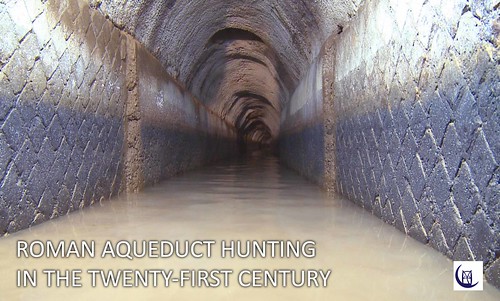
Cold, wet, in the pitch black, twenty-five metres under the city of Rome, we pushed forwards against the water of Marcus Vespanius Agrippa’s Aqueduct, which has flowed continuously since 19BC, and I prayed that our new high-definition camera wasn’t going to drop into the water and flow all the way back to the Trevi fountain.


Our first filming adventure inside an aqueduct was a one-off. We had spent six months negotiating for access to the Aqua Virgo and we knew we weren’t going to have a second chance. Wearing chest-high fishermen’s waders, which often barely covered us from the water, six of us set off from the “Pincio Snail” near the Spanish Steps, and began to push our way upstream.


Often a Roman Aqueduct is portrayed as being carried on elevated arches across the countryside, but in fact, this is only sometimes the case.  The Aqua Virgo has survived almost intact for so many centuries precisely because it travels underground for almost it’s entire route, from Salone on the ancient via Collatina in the east of the city, originally to Agrippa’s baths, of which the Pantheon formed part, and now to it’s display fountain, the Trevi, built in 1732-1762 By Nicolo Salvi.

We took took some very powerful lights to the Aqua Virgo, and we were able to light the underground chambers in a way which we believe has never been done before.  But it was not without difficulty.   We took two battery packs with mains inverters because the lights work on 240V, but only one of us was able to carry a battery pack, and within that pack, one of our batteries had become detached.

Our consultant speleologist was carrying both the battery pack and the light, whilst I was filming, and the 240V cable between the two very nearly dangled in the water on several occasions!  Very soon, furthermore, the mains inverter started to beep, indicating that we were running out of power, so for 40 minutes or so, we had to turn the lights off and push upstream with only the power of tiny safety lights we were wearing on our heads.

The Aqueduct Hunter Diary

My name is Ted O’Neill, I come from Finchampstead in the U.K. and I am blogging from Rome, where my company is researching and filming the remains of the ancient Roman Aqueducts.


Ancient Rome was not only a Military Powerhouse, but also, in many ways an unsurpassed civilisation and healthy population centre, all powered by clean, fresh water.  There was more fresh water arriving in Rome in the year 110 AD than arrives in New York in 2010 AD.   The water was not only good to drink, coming from fresh mineral springs and aquifers around volcanic basins, but it was also a source of renewable energy to roman industry.


In the course of our research we have made some discoveries, and last week, we announced one of them to the world.   The Hotel Quirinale Press Conference was a highlight so far of this project, if not in terms of adventure, then definitely in terms of recognition and fun.

We had not closed our eyes for more than an hour in the three or four days before the press conference.   It was manic.   We had planned to use those days for editing video, but the journalists just didn’t give us a chance.


The conference was hosted by the Mayoress of Manziana, the little town where the chapel / nymphaeum and Traianic water source is located.  Archaeologist Lorenzo Quilici spoke of the unparalled importance of the site, as one of the only Aqueduct sources known in and around Rome, and how it remained unknown for so many centuries due to being completely underwater.

The Aqua Traiana was one of the last, and one of the greatest aqueducts built by the Roman Empire, and it flowed around Lake Bracciano – a volcanic lake to the north of Rome in a question-mark shape, taking pure aquifer water from sources around the volcanic basin, then delivering that water to Rome along a thirty-five mile long conduit.


In the coming weeks I shall be recounting our adventures – Hunting for the Roman Aqueducts, and evidence of their ancient power and engineering.


Images of our work can be seen at our flickr site:  flickr.com/meonhdtv